
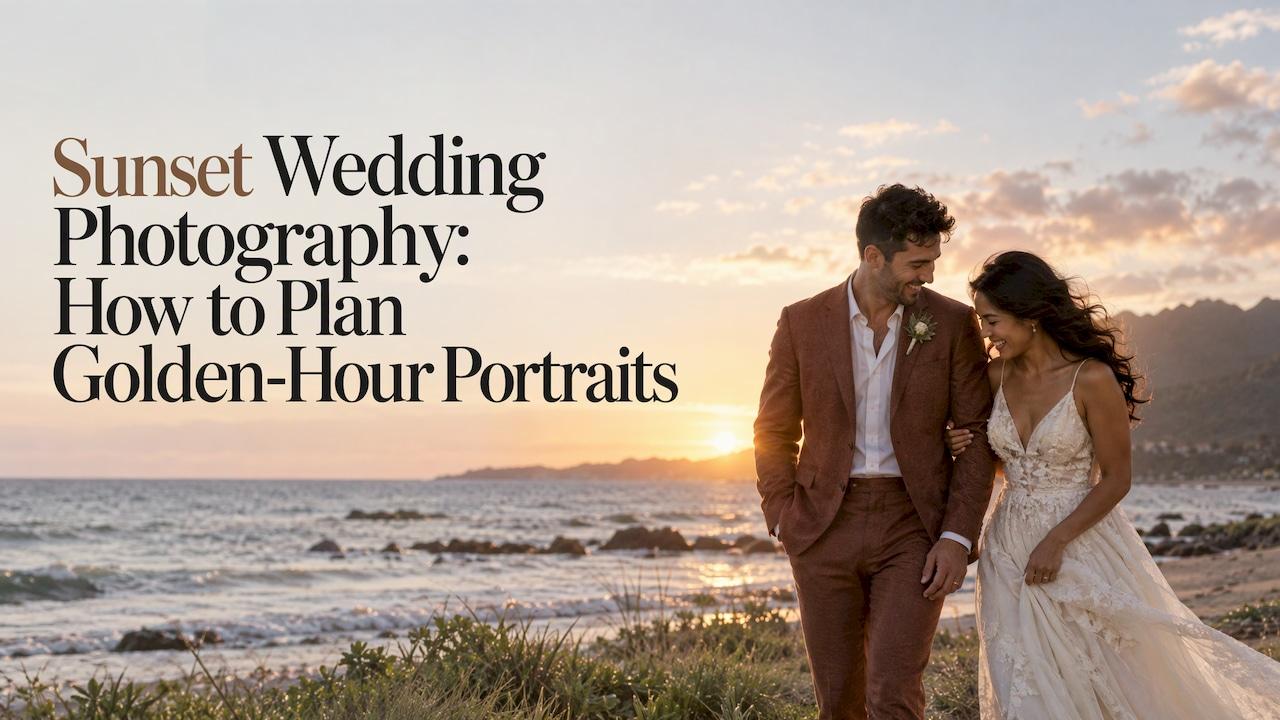
The best sunset wedding photography comes from one decision: building your day around the sun instead of squeezing the sun into your day. Set aside 15 to 20 minutes of the last hour before sunset, slip away with your photographer, and let the light do the heavy lifting. On Oahu, I plan weddings this way because the sky over the water does something no flash or filter can copy. And if standing in front of a camera makes you nervous, this is also the easiest part of the day to relax into.
Below is how it works: when golden hour really happens, where it fits in your timeline, how photographers shape the light, and how to keep the whole thing from feeling like a performance.
TL;DR
- Golden hour is roughly the hour before sunset, plus about 10 minutes after. Your best light sits inside that window, so plan around it.
- You don't need the whole hour. A 15 to 20 minute portrait slip-away is enough when the timing is right.
- Schedule the ceremony so it ends close to sunset, or step out during dinner, and hide your absence behind a toast, a slideshow or a dance set.
- Backlight, silhouettes and a touch of fill light make the glow. A photographer who has scouted the spot makes it look easy.
- Relaxed couples get better photos. Play, move and talk instead of holding stiff poses.
Table of Contents
- Why couples choose sunset photos
- When golden hour actually happens
- Where sunset portraits fit in your timeline
- How photographers shape the light
- How location changes everything
- Making it feel relaxed, not staged
- Are sunset photos worth the time?
- What this looks like with Brandon Smith Photography
- A simple planning checklist
- FAQ
- Sources
Why couples choose sunset photos
Picture the last stretch of daylight. The sun drops low, the light turns warm and soft, and skin looks like it has been lit from the inside. Shadows stretch out and get gentle. The sky shifts from gold to peach to pink. That is the whole appeal of sunset wedding photos: flattering light, a dramatic backdrop and a few quiet minutes together after a very full day.
That last part matters more than people expect. By sunset you've done the ceremony, hugged half your family and answered the same "how are you feeling?" question forty times. Stepping outside for a few minutes gives you a breather with your new spouse, and the photos tend to show it. The best frames are rarely the posed ones. They're the laugh, the forehead touch, the shoulder squeeze while you both catch your breath.
When golden hour actually happens
Golden hour is not a precise moment. The Los Angeles Times wedding timeline guide describes it as usually the hour before sunset and the first 10 minutes or so afterward. It also notes that if the sun drops behind mountains or buildings, golden hour may shift earlier.
That second point matters in Hawaii. On Oahu, a ridge, a high-rise or a cloud bank near the horizon can cut your direct sun sooner than the posted sunset time. A beach facing west gives you a long, open show. A spot tucked behind the Koʻolau side of the island, or between hotel towers in Waikīkī, may lose the sun early. That is why location scouting is part of the plan, not an afterthought.
Here's the other number worth knowing. According to Brides, the average sunset in the United States lasts 33 minutes. The advice there for a sunset ceremony is to plan the vows about 30 minutes before the scheduled sunset, so the ceremony wraps up as the sun is going down and guests still have time to move on to cocktail hour.
A few practical takeaways:
- Look up the sunset time for your exact wedding date. It changes through the year, so don't borrow a time from a friend's wedding in another season.
- Count backward. Your portrait window should start roughly 30 to 45 minutes before that time.
- Leave a buffer. Clouds, a late cake cutting or a long hug line can eat ten minutes quickly.
- Ask about the site. Where exactly will the sun be, and what will block it?
Where sunset portraits fit in your timeline
There are two common ways to do it. Which one works depends on your ceremony time and the season.
Option one: the ceremony ends at sunset
If you're getting married in the late afternoon, schedule the vows so you're pronounced married right around the time the light turns golden. You walk straight into portraits with the light already beautiful, then rejoin your guests at cocktail hour. This is the least stressful setup because nobody has to disappear mid-party.
The tradeoff is that family formals and group photos also need a home. I'd suggest doing as many as possible before the ceremony, so that after the vows you can hand your photographer the golden window and keep it for the two of you.
Option two: the dinner slip-away
If your ceremony is earlier, you can step out during the reception. The idea is simple: when the light gets good, you and your photographer slip outside for about 15 to 20 minutes, then come back for the next part of the night.
The trick is to make your absence invisible. Plan the slip-away for a moment when the room has something else to watch: a toast, a slideshow, a course change or the band's first set. Guests barely notice you've left, and you don't miss anything you care about. Tell your coordinator or DJ the exact window ahead of time so they can keep the energy up.
A sample reception flow might look like this:
| Time relative to sunset | What's happening |
|---|---|
| 90 minutes before | Dinner begins, toasts lined up |
| 45 minutes before | Final check on the sky and location with your photographer |
| 30 to 20 minutes before | You slip out for portraits while a toast or slideshow runs |
| Sunset | Silhouettes and backlit frames, the dramatic ones |
| 10 minutes after | Last soft glow, then you head back inside |
These are planning guides, not rules. Your venue, your guest count and the season will move the pieces around. What stays fixed is the sun.
How photographers shape the light
You don't need to know camera settings to enjoy sunset photos. But understanding what your photographer is doing helps you cooperate with them, and it explains why a few extra minutes of patience pays off.
Backlight: the glow
When the sun sits low behind you, it outlines your hair and shoulders in warm light. Photographers call this backlight or rim light. Professional photographer Alison Carlino, writing for the Professional Photographers of America, says back or rim light is one of her favorites. She describes using it with a small flash behind the couple, or even letting the flash flare into the lens for extra drama.
What does that mean for you? Your photographer will often turn you so the sun is behind you. It can feel odd (you may not be looking at the prettiest part of the sky yourself), but the camera sees a soft halo around the two of you.
Silhouettes: the drama
A silhouette happens when the sky is brighter than the couple, so you become dark shapes against color. It works best when the sky is doing something interesting and when your poses have clear outlines: a dip, a kiss, a veil or dress catching the breeze, hands joined and lifted. Keep a little space between you and your partner's face and arms so the shape reads well.
Silhouettes need the real sunset moment, which is the shortest window of all. That's why the portrait slip-away shouldn't start at the last minute.
Fill light: keeping faces visible
When the sun is behind you, your faces fall into shadow unless someone lifts them. A reflector or a soft off-camera light brings back a gentle glow without ruining the mood. A good photographer blends it so the photo still looks like sunset, not a studio shot.
How location changes everything
Sunset is a location story. The same light looks completely different over open ocean, a park lawn, a cliff edge or a city skyline.
- Open beach facing west: the longest, most colorful show, with water reflecting the sky. Ideal for silhouettes and wide frames.
- Sheltered cove or palms: softer, more intimate light that can fade earlier when trees or hills block the sun.
- Garden or estate venues: lovely warm light filtering through leaves, but you'll want to know exactly where the sun falls.
- Weather: a few clouds are your friend because they catch color. A heavy, solid overcast can flatten the sky. Your photographer can often shift to a different spot or a different style when that happens, which is another reason to talk through a plan B.
I love helping couples choose where to stand. Oahu has a huge range of settings, and picking the right one for your wedding date and time is part of what I do. I'd rather walk you through two or three options than send you to the first place everyone photographs.
Making it feel relaxed, not staged
Here's the secret nobody puts on a checklist: the light can be perfect and the photos still fall flat if you feel stiff. Sunset portraits work best when you forget about the camera.
Try these with your photographer:
- Start by walking. Hold hands and stroll along the shoreline or path. Movement loosens everyone's shoulders in about thirty seconds.
- Talk to each other, not the lens. Whisper something silly, recall the moment you walked in, or tell your spouse what you noticed during the vows.
- Let imperfect happen. The wind will mess up your hair. A wave may sneak up on your shoes. Those frames usually become favorites.
- Skip the "cheese." A real laugh beats a held smile every time.
- Bring a sip of water and a snack. Sunset arrives right when you may have forgotten to eat. Comfortable couples look happier.
- Wear things that move. A flowy dress or a loose jacket catches the breeze and the light.
If cameras make you anxious, you're not alone, and I mean that sincerely. My approach is relaxed and a little playful: fewer rigid poses, more real moments. Most couples tell me that the sunset portraits turned out to be their favorite ten minutes of the day.
Are sunset photos worth the time?
If you're wondering whether to give up a slice of the reception for them, think about what you get in return. You get the most flattering light of the entire day, a quiet moment as newlyweds and a set of images that look different from everything else in your gallery. Twenty minutes out of a six-hour day is a small trade.
It also doesn't have to cost you the party. With a toast, a slideshow or a band set covering the window, you don't miss dancing, cake or anything else you care about. And if your schedule truly can't spare the time at sunset, even five minutes outside before the light disappears is worth asking your photographer about.
What this looks like with Brandon Smith Photography

I photograph weddings on Oahu, and I build the portrait time around the light for your date, your venue and your ceremony time. I help with location choices, keep the atmosphere easygoing and focus on candid, joyful moments instead of stiff perfection. Your edited images are delivered digitally, with print rights included, and you can order prints through your online gallery if you'd like them.
Wedding photography is published at $650 to $4,800, depending on what your day needs. You can see how the options work on the pricing page, then read more about my Oahu wedding photography.

If you're planning a small elopement-style day, a vacation wedding or a couples session at the beach, my portrait sessions are another good fit. Tell me your date and your ideas, and we'll plan the golden hour together.
A simple planning checklist
Use this as you finalize your timeline:
- Find the sunset time for your date and write it at the top of your schedule.
- Decide whether the ceremony will end near sunset or whether you'll do a dinner slip-away.
- Pick the portrait spot with your photographer and confirm where the sun will be.
- Tell your coordinator, DJ or band when you'll step out so something is happening in the room.
- Move family formals to before the ceremony where you can.
- Plan a backup spot for cloudy skies or wind.
- Pack water, a snack, touch-up basics and comfortable shoes for walking.
- Give yourselves a buffer of ten minutes either way.
FAQ
Are sunset wedding photos worth it?
For most couples, yes. Golden-hour light is warm and flattering, the sky adds drama, and you get a calm moment together after the ceremony. Even 15 to 20 minutes can produce some of the most memorable images of the day.
How long do sunset wedding portraits take?
Plan for about 15 to 20 minutes of actual shooting, plus a couple of minutes to walk to the spot. That's enough for backlit portraits, a few silhouettes and a handful of relaxed, candid frames. A little extra time lets you breathe instead of rushing.
When should I start sunset photos?
Begin roughly 30 to 45 minutes before the scheduled sunset so you catch soft golden light first and the more dramatic colors at the end. If trees, hills or buildings block the sun at your venue, start earlier, because the light may fade before the posted sunset time.
How do I do sunset photos without missing the reception?
Plan the break on purpose. Schedule it during a toast, a slideshow, a course change or the band's first set so guests are busy. Tell your coordinator or DJ the window ahead of time, and you'll be back before anyone wonders where you went.
Sources
- How to Plan a Sunset Wedding, Brides
- How to Create a Wedding Timeline, Los Angeles Times
- Front, Side, and Back Lighting Techniques Explained, PPA